
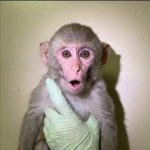




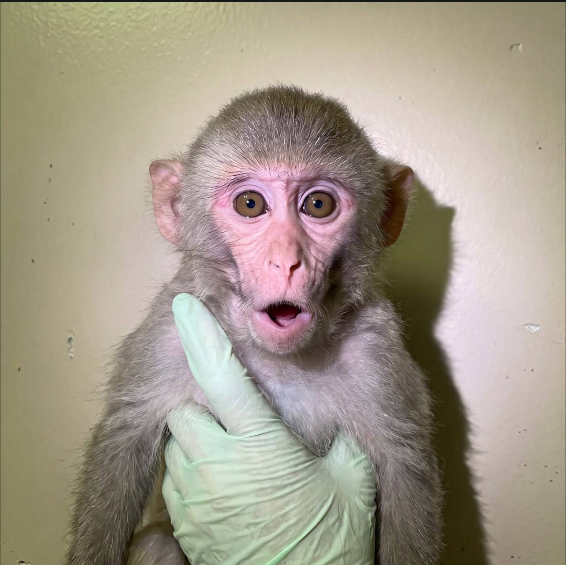
An investigation into soaring prices for laboratory macaques and advances in artificial intelligence-assisted brain interfaces led to an anonymous former caretaker’s account of unusual experimental results and the unexplained death of a research animal.
An investigation into China’s increasingly expensive laboratory macaques took an unexpected turn when an online account surfaced describing unusual events involving an experimental animal identified as M1073.
The post, written by someone claiming to have worked at an unnamed research facility, described recognizable words appearing on a computer display during neural-interface experiments, changes in the macaque’s behavior and its subsequent euthanasia.
The account emerged amid growing demand for experimental primates and advances in artificial intelligence-assisted brain-computer interfaces. Published research documented increasingly sophisticated experiments involving neural implants and robotic systems, but offered no independent confirmation of the events described in the post.
While the account was still circulating, the journalist contacted its author and subsequently interviewed the former caretaker. The conversation provided a fuller chronology of M1073’s final weeks and introduced an allegation that had not appeared in the original post.
It also exposed significant gaps in what could be established.
Rising Prices and a Growing Research Industry
China’s laboratory macaque market has experienced a sharp increase in prices, driven primarily by pharmaceutical development, preclinical testing and constraints on breeding capacity.
Procurement figures reported by Chinese financial publication Yicai show that the price of a research-grade cynomolgus macaque rose from approximately RMB 92,000 in May 2025 to RMB 131,000 in March 2026 and RMB 178,000 in June. By July, some industry quotations were approaching RMB 200,000 per animal.
Breeding capacity is difficult to expand quickly. Macaques take years to mature, and research institutions require animals that meet specific health and screening standards.
Pharmaceutical testing remains the principal source of demand, although experimental macaques are also used in neuroscience and brain-computer-interface research.
These studies can involve surgically implanted devices, repeated experimental sessions and extended periods of observation. Their scientific value is accompanied by questions about animal welfare, particularly when invasive procedures are involved.
M1073 | SCIENCE & TECHNOLOGY 1
Advances in AI-Assisted Brain Interfaces
In May 2026, the Nanjing Institute of Artificial Intelligence reported a brain-computer-interface demonstration involving Zhongke Yixiang and research partners.
The system decoded a macaque’s intention to grasp an object in approximately 0.2 seconds.
Artificial intelligence then planned the movements of a robotic arm and dexterous hand, completing the task in less than three seconds.
The demonstration showed how neural activity could be interpreted and translated into physical actions through AI-assisted robotic control. Researchers are exploring such technologies for potential applications in assistive devices for people with impaired movement.
Publicly reported developments also indicate growing investment in the specialized infrastructure required for these experiments.
In September 2025, Jiangsu Lingkang Biotechnology announced cooperation with Zhongke Yixiang involving surgical-navigation technology for experiments using macaques and other large research animals.
On September 11, 2026, Junction News reported preliminary discussions between Zhongke Yixiang and an experimental macaque breeder in Suzhou. The breeder had offered to provide several macaques without charge in exchange for research cooperation, although the report described a proposed arrangement rather than a confirmed transfer.
The reports establish the broader technological and commercial environment in which experimental macaques are being used. They provide no evidence connecting the named organizations to M1073 or the laboratory described by the former caretaker.
An Account From an Unnamed Laboratory
The M1073 post appeared several weeks after its author had resigned from an unnamed research facility.
It described behavioral changes following repeated neural-interface procedures, unexpected language-related output from experimental equipment and the macaque’s subsequent death.
The journalist contacted the author while the post remained online. It later disappeared, although the reason for its removal could not be determined.
The former employee agreed to an interview on condition of anonymity, citing concerns about being identified. The caretaker also declined to name the laboratory or disclose its location.
That decision imposed a substantial limitation on the investigation. Without identifying the facility, it was not possible to seek an institutional response to the allegations, examine its experimental records or independently establish the circumstances of M1073’s death.
M1073 | SCIENCE & TECHNOLOGY 2
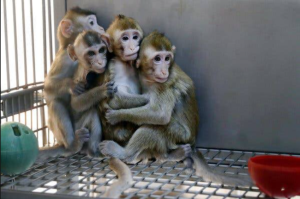
The caretaker described responsibility for the macaque’s daily care over several months, including feeding, monitoring its condition and assisting with recovery following surgical procedures. The former employee was not responsible for operating the neural-interface equipment.
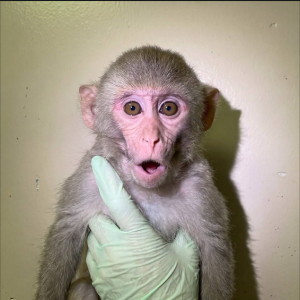
M1073, nicknamed Monkai by the caretaker, was initially described as playful and accustomed to familiar staff members and laboratory routines.
The macaque had become familiar with computer-based experimental tasks, and its attentiveness to the equipment initially appeared consistent with its training.
The caretaker reported that its behavior changed following repeated procedures.
Words on the Experimental Display
According to the former employee, the computer system ordinarily displayed movement-related signals and responses associated with predefined experimental tasks.
During later sessions, short sequences of recognizable Mandarin words appeared on a connected display outside the expected task responses. English words were reportedly observed during subsequent sessions.
The caretaker said the output was unusual enough to bring to the attention of researchers, who subsequently reviewed records generated by the system.
The former employee could not determine whether the characters originated from M1073’s neural activity, the software interpreting those signals or another component of the equipment.
During the same period, the macaque reportedly became increasingly agitated and less responsive to familiar handling routines. Feeding and monitoring became more difficult.
Access to certain experimental sessions was also restricted, although the caretaker could not establish whether the restrictions were related to the review of the computer records.
The observations differ significantly from the capabilities demonstrated in publicly documented brain-interface research.
The May 2026 demonstration concerned decoding movement intentions and controlling robotic equipment. It did not involve generating words or interpreting complex language from macaque neural activity.
No technical records, screenshots or independent testimony were available to establish the origin of the words described by the caretaker. Their appearance on a computer display, even if accurately recalled, would not by itself demonstrate that the macaque had intentionally produced them.
M1073’s Final Days
The caretaker’s last interaction with M1073 involved routine feeding and monitoring.
When the former employee next reported for duty, they learned that the macaque had been euthanized. No detailed explanation was provided.
M1073 | SCIENCE & TECHNOLOGY 3
The caretaker resigned several days later and published the online account several weeks afterward.
During the interview, the journalist asked the former employee to distinguish between events personally witnessed and information learned from other laboratory staff.
The distinction became important when the caretaker disclosed an additional allegation.
Following M1073’s death, a researcher had allegedly mentioned unusual activity involving the experimental computer system, including an attempted transfer of information to an external server.
The detail had not appeared in the original online post.
The caretaker explained that the post had been limited to firsthand observations. The reported server activity was different: it had been mentioned during a conversation with another employee.
The former caretaker had not examined the system logs and could not determine what information was involved, what initiated the reported activity or whether any transfer succeeded.
The allegation therefore rests on a recollection of a conversation, rather than direct examination of technical evidence.
There is also no established connection between the reported server activity, the unexpected computer output and the decision to euthanize M1073.
Without access to the laboratory, its records or an account from the researchers involved, the circumstances of the macaque’s death remain unresolved.
The Questions Beyond M1073
China’s expanding use of laboratory macaques reflects an important area of scientific development.
Research involving neural implants, artificial intelligence and robotics may eventually contribute to treatments and technologies that improve human lives.
It also depends on animals undergoing procedures that require careful welfare oversight, appropriate veterinary care and decisions about their continued participation in experiments.
Research animals may be euthanized at the conclusion of approved studies or for welfare-related reasons. The caretaker’s account does not establish whether either circumstance applied to M1073.
The investigation identified a broader research environment in which macaques are increasingly valuable and neural-interface technology is advancing rapidly. It also documented the former caretaker’s account of unusual experimental observations and an animal’s death.
What it could not establish was whether the reported computer output originated from M1073’s neural activity, whether any attempted server transfer occurred or why the macaque was euthanized.
Those uncertainties are central to the account, not evidence of a particular explanation.
M1073 | SCIENCE & TECHNOLOGY 4
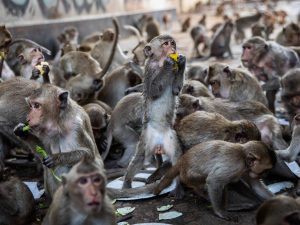
For the caretaker, the last firsthand memory of M1073 was an ordinary visit to feed and monitor an animal that had become familiar over months of daily care. By the next shift, the macaque had been euthanized.
The reason, according to the former employee, was never explained.
PUBLISHED RESEARCH AND INDUSTRY REPORTING
- Yicai — Laboratory macaque prices and supply constraints
https://m.yicai.com/news/103270605.html
- China Securities Journal — Macaque shortages and pharmaceutical demand
https://finance.sina.com.cn/jjxw/2026-07-15/doc-inihwvwy4753653.shtml
- Nanjing Institute of Artificial Intelligence — AI robotic-hand demonstration
https://www.airia.cn/index.php/news/102.html
- Nanjing Municipal Government — Brain-interface demonstration
https://qilinpark.nanjing.gov.cn/ztlm/kjc/202605/t20260519_5842627.html
- Jiangsu Lingkang Biotechnology — Research cooperation
https://www.lkbio.com.cn/news/250
- Jiangsu Lingkang Biotechnology — Research platform
https://www.lkbio.com.cn/news/248
- Junction News / Xinhua Daily — Preliminary breeder discussions
https://www.xhby.net/content/s6aa3f08ae4b0c7c3ee73ccb6.html



More Stories