





Many people assume that CCTV footage recorded by a DVR or NVR will remain available for years unless someone manually deletes it.
In most surveillance systems, that is not how recording storage works.
A DVR or NVR is usually designed to record continuously or according to a schedule. When its storage becomes full, the system may automatically overwrite the oldest recordings with new footage. Some systems can also be configured to retain recordings for a specific number of days.
This means that important CCTV footage can disappear automatically if it is not backed up or exported in time.
Understanding how long your DVR or NVR can actually retain recordings is therefore an important part of CCTV data management and data recovery.
Does a DVR or NVR Store CCTV Footage Forever?
Normally, no.
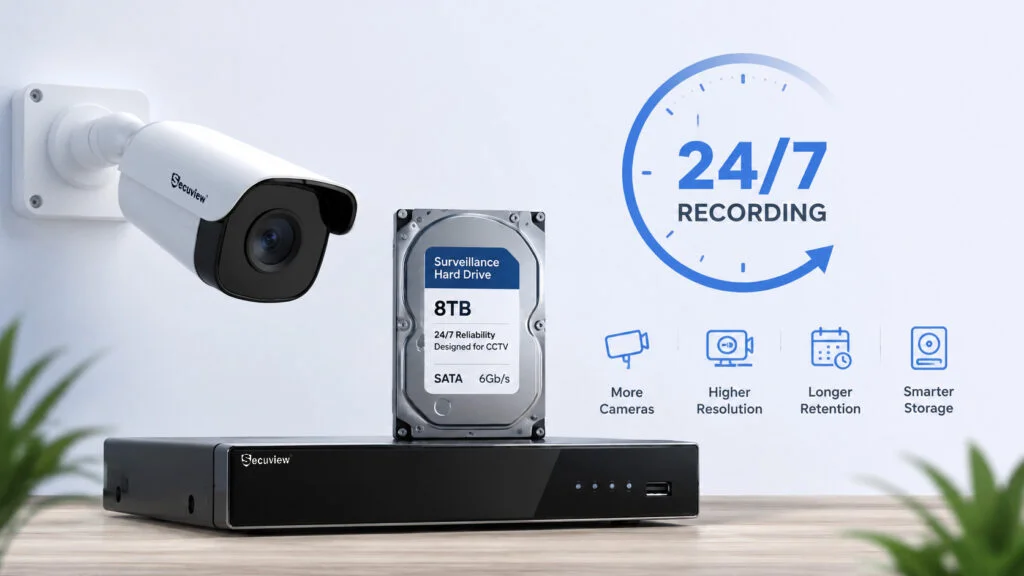
Most DVRs and NVRs use a storage drive, commonly a surveillance-rated hard disk drive, to store recorded video.
When the available storage becomes full, many systems use an overwrite or recycle function. The recorder removes or overwrites older footage to make room for newer recordings.
For example, suppose a surveillance system effectively retains approximately 30 days of recordings.
If an important event occurred 45 days ago and no separate backup was made, that footage may already have been overwritten by newer recordings.
Some recorder models allow users to configure a specific retention period, while others primarily recycle recordings based on available storage capacity.
Therefore, the important question is not simply:
“How many years can a DVR or NVR store video?”
The better question is:
“How many days of recording can this particular system retain before older footage is overwritten or expires?”
How Many Days of CCTV Footage Can Be Stored?
There is no single answer that applies to every DVR or NVR.
Retention time depends on several factors, including:
– Hard drive capacity
– Number of cameras
– Camera resolution
– Video bitrate
– Frame rate
– Compression technology
– Continuous or motion/event recording
– Recording schedule
– Number of recording channels
– Audio recording
– Recorder configuration
– Retention or overwrite settings
A larger hard drive can generally store more footage, while higher recording bitrates consume storage more quickly.
For example, a system recording many high-resolution cameras continuously may use storage much faster than a system recording fewer cameras at a lower bitrate or only during motion events.
This is why two CCTV systems with the same HDD capacity may have very different recording retention periods.
What Happens When the HDD Becomes Full?
In many DVR and NVR systems, the default or configured behavior is to overwrite the oldest recordings.
This is commonly called overwrite, recycle, or loop recording.
The basic process is:
New video is recorded → storage gradually fills → HDD reaches its configured threshold/full capacity → oldest footage is overwritten → new footage continues to be recorded
This allows the surveillance system to continue recording without requiring the user to manually delete old footage.
Several manufacturers document this behavior in their recorder manuals. For example, DVR/NVR documentation describes systems that automatically overwrite the oldest footage when storage becomes full.
Some Systems Have a Specific Retention Period
Not every system relies solely on the HDD becoming full.
Depending on the recorder and firmware, users may be able to configure a specific recording retention period.
For example, a recorder may be configured to retain recordings for 7, 14, 30, 60 or 90 days, depending on the model and available settings.
Some systems can delete or overwrite recordings once they reach the configured age, even when there is still unused storage capacity.
Therefore, checking the recorder’s actual storage and retention configuration is important.
For example, certain NVR systems allow a user to configure a video keeping period, after which older recordings are automatically removed.
Why CCTV Footage Can Disappear Without Anyone Deleting It
One of the biggest misunderstandings about DVR/NVR storage is that missing footage must have been manually deleted.
That is not necessarily true.
If automatic overwrite is enabled, the recorder itself can replace older footage with new recordings.
For example:
Day 1: CCTV footage is recorded.
Day 30: The HDD is approaching its usable storage limit.
Day 31: New footage continues to be recorded.
Older footage: The oldest recordings begin to be overwritten.
As this process continues, footage from previous days gradually disappears from the recorder’s accessible recording history.
No person needs to press a delete button.
Why You Should Back Up Important CCTV Footage
If a particular incident may become important later, relying only on the DVR or NVR’s internal HDD is risky.
Important footage may include:
– Theft or burglary
– Property damage
– Accidents
– Workplace incidents
– Security events
– Disputes
– Missing-person investigations
– Business-related incidents
– Insurance claims
– Legal evidence
If the relevant footage is not exported or backed up before the recorder overwrites it, recovery may become much more difficult.
The safest approach is to identify important footage as soon as possible and create a separate copy.
CCTV Backup Should Be Part of the Security Plan
A CCTV system is not only a camera system.
It is also a data-storage system.
For important surveillance environments, organizations should have a clear policy covering:
1. How many days of footage must be retained?
2. Which footage requires long-term preservation?
3. Where should important recordings be backed up?
4. Who is responsible for exporting footage?
5. How often should backups be checked?
6. How long should backup copies be retained?
Depending on the system and security requirements, backups may be stored on external storage, another server, NAS, or other appropriate storage infrastructure.
Some surveillance recorders also support redundant storage or external storage options for backup purposes.
What If Important CCTV Footage Has Already Disappeared?
If important footage is no longer visible in the DVR/NVR interface, the first step is to determine why it disappeared.
There are several possibilities.
The footage may have:
– Reached the configured retention period
– Been overwritten by newer recordings
– Been deleted or affected by a formatting operation
– Become inaccessible because of HDD failure
– Become corrupted because of a file-system or recorder problem
– Become inaccessible because of a DVR/NVR malfunction
– Been affected by a damaged storage device
These situations are not identical and may require different recovery approaches.
CCTV Data Recovery From a Failed HDD
Sometimes the CCTV footage has not necessarily been overwritten—the problem may simply be that the storage drive has failed.
For example, the DVR/NVR may stop recording or show an HDD error because of:
– Bad sectors
– Mechanical failure
– Electronic failure
– Firmware-related problems
– File-system
For more information about professional data recovery services in Bangladesh, visit:




More Stories
Why Metal Recycling Matters for a Cleaner Future
MacBook Air for Freelancers: Everything You Need to Know
What Features Should a Smart HR Software Have